
By Laura Redford
Like walking, there are lots of personal and community benefits when people choose to use a bike instead of a car:
- Improved physical and mental health
- Better air quality, fewer car emissions
- Less traffic
- No need to hunt for a parking spot
- Greater mobility for those who don’t drive
Bikability is directly connected to bike infrastructure. Thankfully, our national biking infrastructure standards improved dramatically in 2024 when the American Association of State and Highway Officials (AASHTO) updated the “Guide for the Development of Bicycle Facilities.” This is the manual planners, engineers, and others consult to know how to build which kind of bike infrastructure where. It does NOT say what HAS to be built where–that’s up to local decisions.
Previous to this revision, many U.S. cities often only planned biking for “highly confident” cyclists, those who are comfortable riding amidst cars, only 4-7% of the population. Most riders, however, want more protection. The federal highway administration used this image in one of its manuals to show what infrastructure applies to which group of riders.
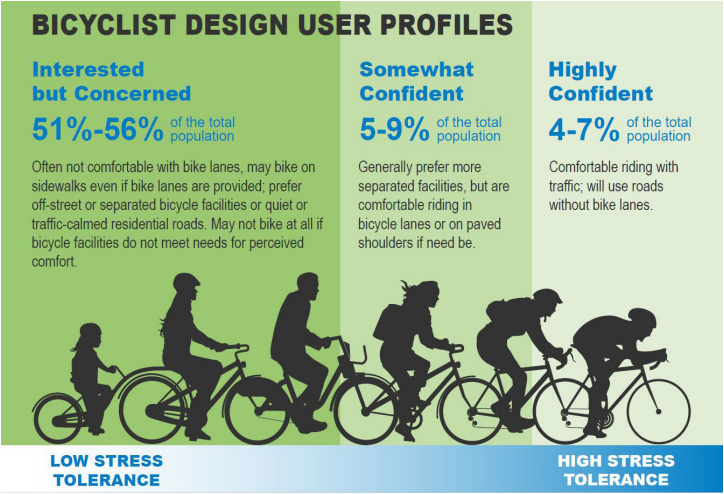
Assuming biking should be available to as many people as may want to use it as a transportation option, AASHTO’s revised guidelines plan for the “interested but concerned” rider (51-56% of the population) and offer four essential principles for successful biking infrastructure:
Safety: Reduce high impact accidents between cyclists and cars by separating bikes from high volume, high speed motorists.
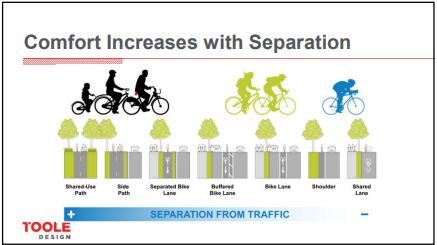
Comfort: Riders feel safe to use it. Toole design made this image to show which group of riders feels comfortable at what level of bike lane protection or separation.
Connectivity: Direct routes that are complete and contiguous. The bike infrastructure has to take people where they want to go. Missing sections of a bike facility, or not planning for intersections deters the interested but concerned biker from using their bike.
Legibility: The intended routes for bikes need to be easy to see and understand. This could involve signage, painting, and community outreach.
When these principles are applied, more people choose to ride bikes.The onus of bike safety is often put on the people riding the bikes. But, infrastructure can and should take responsibility for some of that safety. In 2025, researchers from the University of New Mexico examined six years of data in 28 U.S. cities and found that ridership went up in places that had protected bike lanes. Other research shows a decline in accidents on streets with bike infrastructure. When talking about the number of people choosing to ride bikes, the famous phrase from the movie Field of Dreams rings true: “If you build it, they will come.”
Leave a Reply